

- Admin
- #1
- Joined
- May 21, 2021
- Messages
- 2,602
- Reaction score
- 1,545
- Points
- 113
- Location
- Stuart, Florida
- Website
- themikephillipsforum.com
Does a person need MORE than one polisher?
I get a lot of questions about car detailing via email and/or all the different types of ways we communicate on social media platforms like YouTube, Facebook and Instagram.
I never mind answering people, but with email, only ONE set of eyeballs see the answers. Yet we all know, if one person has a question, it's highly likely other people have the same question. So, in order to LEVERAGE my typing time, (I'm on the clock so there must be a benefit to the company), I simply answer questions on this forum. PLUS - Google does a GREAT job of analyzing the content on this forum and then ranks it high in the search results. So helping one person, ends up helping a lot of other people and that's what I'm all about.
Here's a recent question from YouTube.
Hey , do we need different types of polish or one is enough???
Btw love the way you teach. Some people are saying you talk too much, but you have shared every single bit of information which is necessary to do this type of car detailing.
Thanks
First, to answer your question. In my honest opinion, the most versatile and efficient tool for someone starting out would be the Griot's Garage G9. Below is a picture from my September 2-Day Class with one of the students using the G9 on a 1979 Corvette. See all the pictures from that class here.
Griot's Garage G9 Free Spinning Random Orbital Polisher
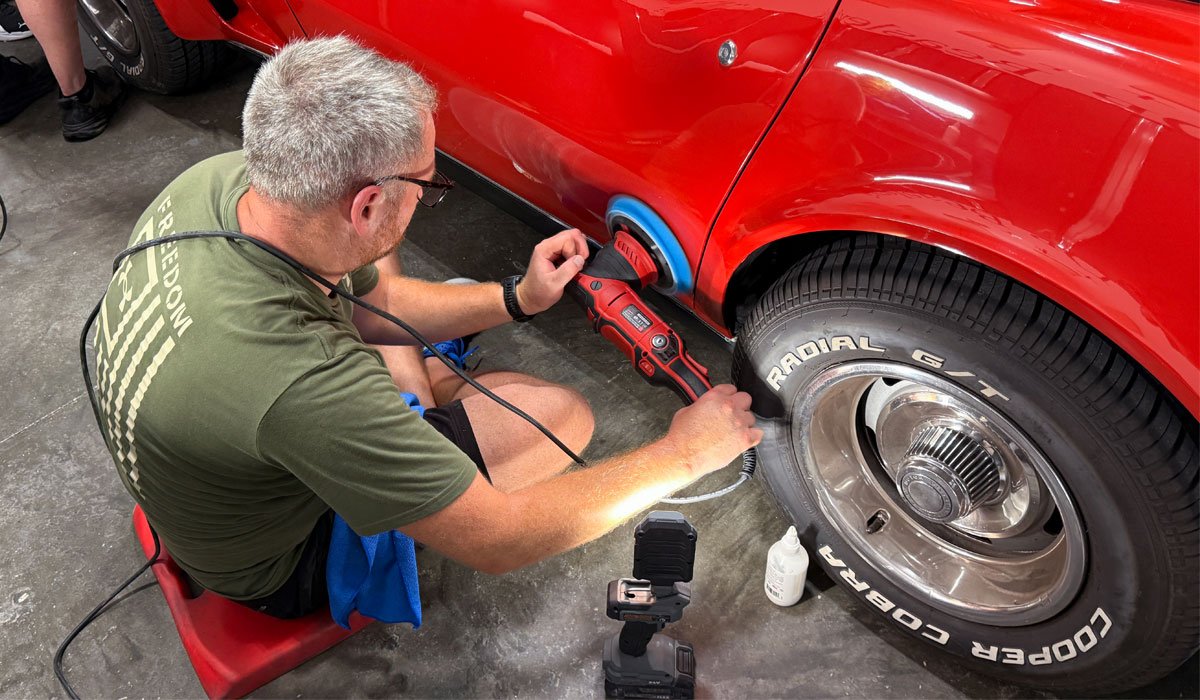
This is a 9mm free spinning, random orbital polisher. Out of all the free spinning, random orbital polishers I've used over the decades, (and that's a lot), this short stroke polisher does the best job of maintaining pad oscillation and pad rotation, which is what you NEED in order to do any type of paint correction in a time-efficient manner.
The DOWNSIDE is, because it’s a free spinning, random orbital polisher you will experience pad stalling when buffing concave curves, moving the polisher over adjacent planes, thin panels and tight areas.
The UPSIDE is, because it’s a free spinning, random orbital polisher, it’s *SMOOTHER* on you to hold the tool for hours while buffing out a car.
The other option would be the Harbor Freight Forced Rotation Dual Action Polisher, which is an 8mm GEAR-DRIVEN orbital polisher. Notice I’ve dropped the word RANDOM when describing the tool. Because it’s gear-driven, the orbit pattern is mechanically fixed (gears), and thus the pad oscillates and rotates in an exact, defined orbit stroke pattern, thus no randomness.
The UPSIDE is because it’s gear-driven, there’s ZERO Pad Stalling. So, it’s faster overall to buff out an entire car no matter what the shape of the body panels.
The DOWNSIDE is, because it’s gear-driven, it has a LOT of power, and this power can show up as the tool feeling like it’s *pulling* you in one direction or the other. A lot of people don’t like this, and they are willing to use a slower tool that can suffer from pad stalling because it’s smoother to hold and use for hours.
The pulling you can feel is referred to as the walking-effect and what this means is there is more pressure on one side of the buffing pad, and this causes the pad to grab harder, which then moves the tool in a way that it feels like it’s pulling you in some direction.
The word pulling starts with the letter P and so does the word POWER. So, what you experience is the increased power a gear-driven orbital polisher has as compared to any free spinning, random orbital polisher no matter what the brand or the orbit stroke length.
There is another DOWNSIDE to gear-driven orbital polishers, and this is, this power aspect also means it’s more difficult to finish out perfectly on SOFT paint. This is why in a lot of my work, I’ll start with a gear-driven orbital polisher, but I’ll finish with a Griot’s Garage G9 or a simple Porter Cable 7424XP.
Here’s the link to my video and review for the Harbor Freight Forced Rotation Dual Action Polisher
Review: Harbor Freight Forced Rotation Dual Action Polisher
Pad Stalling Video
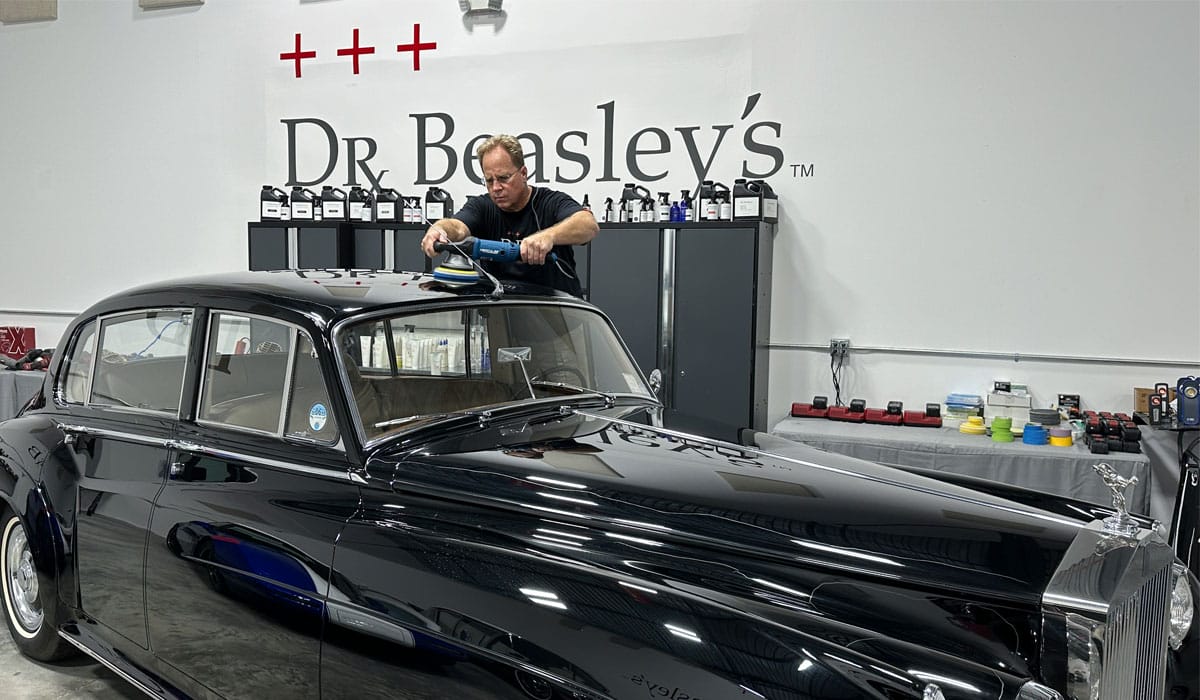
I would also recommend watching this video as it shows pad stalling for multiple polishers to give you an idea for how multiple tools react when buffing concave curves.
Me? When I need a gear-driven, orbital polisher, I grab the FLEX Supa BEAST. I’m the guy that gave this tool, as well as other tools, their nicknames simply due to the volume of text I type each year, and I don’t like typing our or even trying to remember part numbers. That said, the part number for the Supa BEAST is FLEX XCE 10-8 125
Besides being more expensive than the Harbor Freight copy, it is much higher quality and unlike most, if not all other polishers on the market, they don’t use the FLEX 7-Function Microprocessor to operate the tool.
See my article here,
The 7-Function Microprocessor Inside all FLEX Polishers by Mike Phillips
And of course, I use the other type of gear-driven polisher a LOT and that’s a rotary polisher. Most people don’t think of them as gear-driven, but it’s a fact. And like a gear-driven orbital polisher, it has a lot of power.
Second – thank you for the kind words. I read people’s comments that I talk too much, but if I’m talking, I’m probably teaching, or sharing information that explains something. Plus, I think our best videos are long format and the masses are being conditioned for short videos, which leads to short attentions spans.
Hope the above helps…
Mike
I get a lot of questions about car detailing via email and/or all the different types of ways we communicate on social media platforms like YouTube, Facebook and Instagram.
I never mind answering people, but with email, only ONE set of eyeballs see the answers. Yet we all know, if one person has a question, it's highly likely other people have the same question. So, in order to LEVERAGE my typing time, (I'm on the clock so there must be a benefit to the company), I simply answer questions on this forum. PLUS - Google does a GREAT job of analyzing the content on this forum and then ranks it high in the search results. So helping one person, ends up helping a lot of other people and that's what I'm all about.
Here's a recent question from YouTube.
Hey , do we need different types of polish or one is enough???
Btw love the way you teach. Some people are saying you talk too much, but you have shared every single bit of information which is necessary to do this type of car detailing.
Thanks
First, to answer your question. In my honest opinion, the most versatile and efficient tool for someone starting out would be the Griot's Garage G9. Below is a picture from my September 2-Day Class with one of the students using the G9 on a 1979 Corvette. See all the pictures from that class here.
Griot's Garage G9 Free Spinning Random Orbital Polisher
This is a 9mm free spinning, random orbital polisher. Out of all the free spinning, random orbital polishers I've used over the decades, (and that's a lot), this short stroke polisher does the best job of maintaining pad oscillation and pad rotation, which is what you NEED in order to do any type of paint correction in a time-efficient manner.
The DOWNSIDE is, because it’s a free spinning, random orbital polisher you will experience pad stalling when buffing concave curves, moving the polisher over adjacent planes, thin panels and tight areas.
The UPSIDE is, because it’s a free spinning, random orbital polisher, it’s *SMOOTHER* on you to hold the tool for hours while buffing out a car.
The other option would be the Harbor Freight Forced Rotation Dual Action Polisher, which is an 8mm GEAR-DRIVEN orbital polisher. Notice I’ve dropped the word RANDOM when describing the tool. Because it’s gear-driven, the orbit pattern is mechanically fixed (gears), and thus the pad oscillates and rotates in an exact, defined orbit stroke pattern, thus no randomness.
The UPSIDE is because it’s gear-driven, there’s ZERO Pad Stalling. So, it’s faster overall to buff out an entire car no matter what the shape of the body panels.
The DOWNSIDE is, because it’s gear-driven, it has a LOT of power, and this power can show up as the tool feeling like it’s *pulling* you in one direction or the other. A lot of people don’t like this, and they are willing to use a slower tool that can suffer from pad stalling because it’s smoother to hold and use for hours.
The pulling you can feel is referred to as the walking-effect and what this means is there is more pressure on one side of the buffing pad, and this causes the pad to grab harder, which then moves the tool in a way that it feels like it’s pulling you in some direction.
The word pulling starts with the letter P and so does the word POWER. So, what you experience is the increased power a gear-driven orbital polisher has as compared to any free spinning, random orbital polisher no matter what the brand or the orbit stroke length.
There is another DOWNSIDE to gear-driven orbital polishers, and this is, this power aspect also means it’s more difficult to finish out perfectly on SOFT paint. This is why in a lot of my work, I’ll start with a gear-driven orbital polisher, but I’ll finish with a Griot’s Garage G9 or a simple Porter Cable 7424XP.
Here’s the link to my video and review for the Harbor Freight Forced Rotation Dual Action Polisher
Review: Harbor Freight Forced Rotation Dual Action Polisher
Pad Stalling Video
I would also recommend watching this video as it shows pad stalling for multiple polishers to give you an idea for how multiple tools react when buffing concave curves.
Me? When I need a gear-driven, orbital polisher, I grab the FLEX Supa BEAST. I’m the guy that gave this tool, as well as other tools, their nicknames simply due to the volume of text I type each year, and I don’t like typing our or even trying to remember part numbers. That said, the part number for the Supa BEAST is FLEX XCE 10-8 125
Besides being more expensive than the Harbor Freight copy, it is much higher quality and unlike most, if not all other polishers on the market, they don’t use the FLEX 7-Function Microprocessor to operate the tool.
See my article here,
The 7-Function Microprocessor Inside all FLEX Polishers by Mike Phillips
And of course, I use the other type of gear-driven polisher a LOT and that’s a rotary polisher. Most people don’t think of them as gear-driven, but it’s a fact. And like a gear-driven orbital polisher, it has a lot of power.
Second – thank you for the kind words. I read people’s comments that I talk too much, but if I’m talking, I’m probably teaching, or sharing information that explains something. Plus, I think our best videos are long format and the masses are being conditioned for short videos, which leads to short attentions spans.
Hope the above helps…
Mike
Last edited:
